2026 Fleet Technology Trends Report
The 2026 Fleet Technology Trends Report chronicles the latest fleet management technology and AI-driven tools fleet professionals...
Read more 12 mins to read


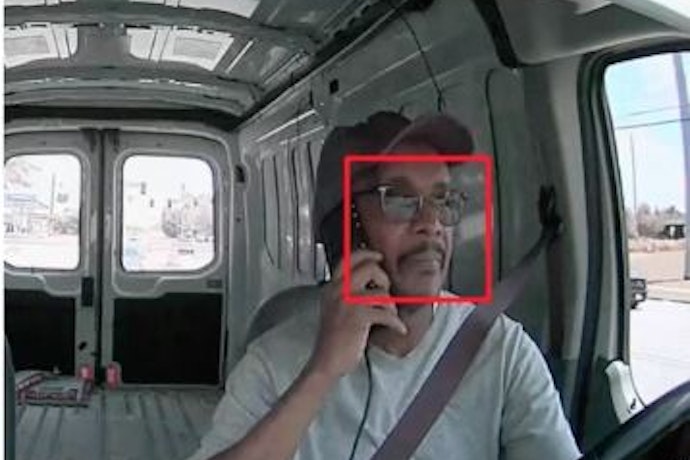
It’s never been easier to get distracted behind the wheel.
Smartphones, in-cab screens and long hours on the road all compete for a driver’s attention.
That’s why fleet safety strategies are increasingly focused on what safety professionals call the "moment of risk" — the 3-to-5-second window when attention shifts away from the road but a collision hasn’t yet occurred. It represents the narrow gap between a distraction (for example, looking at a phone screen) and an actual safety incident.
To tackle the "moment of risk" and help keep drivers on track, fleets can utilize a driver monitoring system (DMS) integrated with their existing telematics solution to keep an eye on driver behavior and encourage safe driving.
A DMS is an AI-powered solution designed to measure driver alertness and engagement in real-time using an in-cab, driver-facing camera. Unlike traditional telematics that focus on the vehicle's location, routing and mechanical state, a DMS uses high-definition sensors and machine learning to analyze driver facial expressions, eye movement and head position. This allows the system to identify the earliest signs of potential impairment before an incident occurs.
|
What is the difference between ADAS and DMS? You might have also heard about Advanced Driver Assistance Systems (ADAS) talked about in tandem with DMS, and it is easy to conflate the two. However, they serve two distinct but complementary roles in your safety infrastructure:
|
According to the latest National Highway Traffic Safety Administration report, distracted driving continues to claim thousands of lives each year — including 3,275 in the most recently reported year.1 The risk for distraction is amplified for commercial drivers because they are almost always alone on the road and often drive at night. The best driver monitoring solutions help tackle this risk using core features that help drivers stay safer on the roads no matter the time of day: visibility and speed.
Standard cameras often fail in low-light conditions or when a driver is wearing tinted lenses. A DMS utilizes specialized infrared (IR) motion sensors to solve this, enabling:
In a safety event, every millisecond counts. While some options might rely on the cloud to analyze footage, the Verizon Connect system utilizes sub-second edge data processing. This provides two big benefits:
Imagine being able to ride along with your drivers on the road. Here are the ways integrated video helps with driver safety and protects fleets like yours.
The power of GPS tracking technology coupled with AI video helps empower fleet companies to
identify unsafe trends, coach individual drivers and reduce accident costs. But while standard telematics might tell you when a driver hits the brakes, an AI dashcam with distracted driving detection tells you why.
At the core of DMS capabilities is a cloud-based video analytics engine that reviews road-facing and driver-facing footage after a driving event is detected. By assessing the severity and analyzing the footage for specific behaviors, the system uncovers hidden patterns that are often difficult for resource-strapped managers to spot manually.
Once this analysis is complete, the AI generates and applies a classification — critical, major, moderate, or minor — based on what it "sees" in the footage. This automated classification helps fleet managers move beyond raw video, shifting from reactive damage control to proactive safety coaching. Instead of manually reviewing hours of footage, managers can prioritize the events that matter most to improve driver behavior and operational safety.
By focusing on the behaviors that lead to those sudden stops — such as handheld phone use, smoking or eating — fleets can shift from reactive damage control to proactive safety coaching.
|
Here are some examples of real-life situations fleets have faced and the results they’ve seen using connected AI dashcams with in-cab alerts. Many report significant, measurable improvements to driver behavior, such as:2
|
It’s common to hear objections about technology that collects data or tracks movement, but smart technology can increase trust within your organization if implemented and messaged correctly. While drivers may be concerned about the level of surveillance, there are two key points you can use to put their minds at ease.
A DMS isn't designed to penalize drivers, it instead intervenes when something outside of normal driving behavior occurs. A distracted driving incident is defined as the driver looking away for two or more seconds, triggering an in-cab audible alert. At 55 mph, looking away while driving for just 5 seconds is equivalent to driving the entire length of a football field blindfolded.1 By triggering a chime and message alert at the two-second mark, distracted driving detection provides a three-second safety buffer to bring the driver’s eyes back to the road before that dangerous distance is covered.
While the driver-facing camera is recording whenever the ignition is turned on and for 15 minutes after it is turned off, Verizon Connect’s DMS comes with privacy caps for the lens, and does not record audio in commercial vehicles. By focusing on data rather than constant “Big Brother” observation, fleets can foster a culture of professional accountability rather than one of suspicion.
One thing to note: A common failure in fleet safety is over-alerting. When every minor event triggers a notification to a manager, it creates a culture of resentment and alarm fatigue. With a "human-centric" hierarchy of feedback, an alert is only triggered when the risk threshold is sustained or severe.
48% of fleets surveyed in our Fleet Technology Trends report said video telematics helped them reduce accident costs. Get the full scoop by downloading the report.
Drowsy driving can be just as serious as distracted or aggressive driving. Drowsy driving is when a driver continues operating a motor vehicle of any kind while being cognitively impaired by lack of sleep or sleep deprivation. Other factors, such as sleep disorders like obstructive sleep apnea, side effects of medication use or alcohol or drug abuse, can also contribute to drowsy driving.
|
Want a drowsy driving versus drunk driving comparison? Research indicates that drowsy driving is as serious as driving under the influence of drugs or alcohol.
|
By the time a driver realizes they are nodding off, the “moment of risk” has often already passed. And the DMS doesn’t wait for a dangerous lane departure or swerve to flag a risk. Instead, it monitors specific biological markers of fatigue that signal drowsiness before a problem occurs:
It’s important to remember that fatigue rarely strikes quickly. Usually, it manifests as a “fatigue loop.” This is a repeating pattern of declining performance that the driver may be subconsciously trying to fight. Big signs include missing road signs because the driver stops processing peripheral information and speed fluctuations because the driver’s foot is oscillating on the accelerator. By breaking the fatigue loop with a real-time in-cab audible alert, the truck driver monitoring system helps prompt the driver to take a necessary break.
Drowsy driving is entirely preventable, and there are some precautions drivers can take to help avoid it. Below are some tips and tricks that drivers can use:
The most valuable asset in any vehicle isn't the cargo — it's the person behind the wheel. Verizon Connect’s technology is designed to help them return home safely every single trip. In fact, 74% of fleets that utilize integrated video say it helped them improve driver safety, according to the Fleet Technology Trends Report.
For fleets considering an investment in a DMS, be sure to look for the following features:
This can offer you the peace of mind you need to help keep drivers safer on the road. With near real-time information and insights at your fingertips, fleets can reduce costs, boost productivity and enhance customer satisfaction while helping drivers operate safely and efficiently.
Don't wait for a "moment of risk," empower your drivers now with the tools they need to self-correct, stay alert and stay safer on the road. Schedule a demo today.
1 National Highway Traffic Safety Administration, Distracted Driving
2 Reveal aggregated customer data

Tags: Cost control, Data & Analytics, Performance & Coaching, Safety, Team Management


Find out how our platform gives you the visibility you need to get more done.
The 2026 Fleet Technology Trends Report chronicles the latest fleet management technology and AI-driven tools fleet professionals...
Read moreLearn how innovations in video powered by AI and machine learning are helping to reshape safety and efficiency.
Read moreWant to hang onto your best drivers? Learn how video-based coaching can aid driver satisfaction and retention.
Read more
When you’re in the trucking industry, driving is what makes you money, but it can also cost you in false claims and accidents.
Read more