2026 Fleet Technology Trends Report
The 2026 Fleet Technology Trends Report chronicles the latest fleet management technology and AI-driven tools fleet professionals...
Read more 10 mins to read


In its broadest sense, telematics is the joining of two sciences: telecommunications, a branch of technology including phone lines and cables, and informatics, such as computer systems. While the term originated in the 1970s to describe the marriage of computers and communication networks, it is now most commonly used in reference to fleet telematics solutions utilized in commercial vehicles.
Wireless telematics devices and other “black box” technologies collect and transmit data on vehicle use, maintenance requirements and automotive servicing. A popular option for modern companies is to utilize fleet management software, which is a branch of telematics, to coordinate the vehicles they manage and gain a comprehensive view of the health, profitability and productivity of their entire fleet.
At its core, a telematics system includes a vehicle tracking device that allows the sending, receiving and storing of data. It connects via the vehicle’s own onboard diagnostics (OBD-II) or CAN-bus port.
The primary hardware component is the Telematics Control Unit (TCU). Think of the TCU as the "brain" of the system; it is a device that collects and governs the transmission of data. The hardware components of a TCU include:
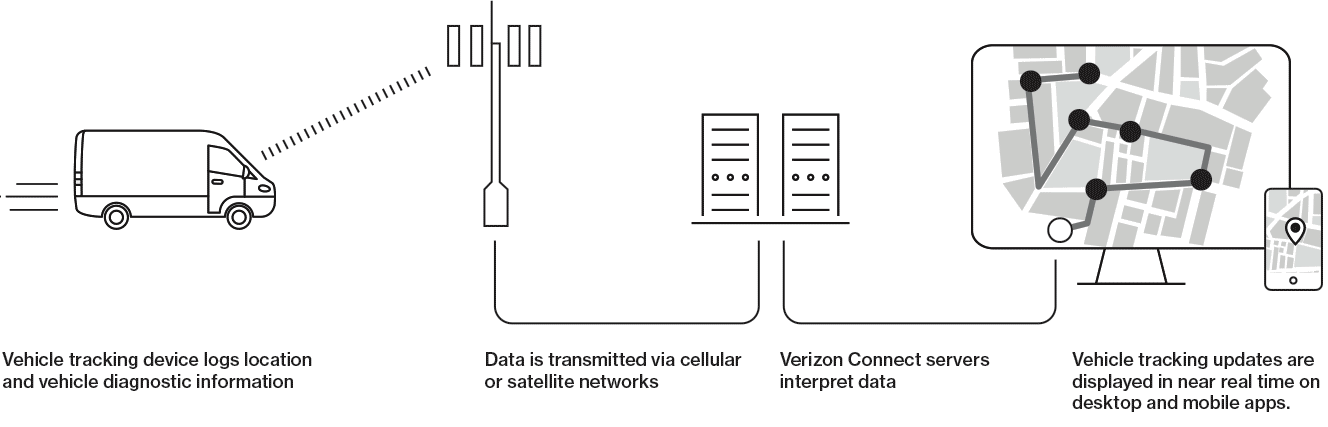
This device collects GPS data and an array of vehicle-specific data and transmits it to a centralized server. This is known as telemetry. The server interprets the data and enables it to be displayed for end users via secure websites and apps optimized for smartphones and tablets.
See how fleet professionals are using this technology today. Download the 2026 Fleet Technology Trends Report.
Many modern commercial vehicle manufacturers install embedded GPS tracking and telematics systems directly in their fleet vehicles. If a vehicle does not come with this technology pre-installed, aftermarket GPS devices are available. These can be battery-powered or powered via the vehicle’s own internal electrical system.
Some original equipment manufacturers (OEMs), including Volvo, Mack, Ford and GM, also partner with telematics providers to provide a seamless end-user experience. In the coming years, the automotive industry will continue to develop smart cars and capitalize on the Internet of Things (IoT) landscape to help connect vehicles to cities and smart traffic technologies.
Telematics solutions can integrate with existing applications and systems to enable an array of use cases for fleets of all sizes, including:
Ready to transform your business? Download our Fleet Management Software Buyer’s Guide to compare features and find the right fit.
Telematics applications have expanded into several other sectors outside of traditional commercial fleet management:
Telematics technology can help fleets achieve operational improvements in key areas:
Telematics can help identify areas of waste, such as vehicle idling or fuel slippage, and allow fleet managers to address them promptly, positively impacting fuel efficiency and the bottom line. It also can help management plan the most efficient route for each driver to reduce unnecessary mileage.
Continuous feedback regarding driving behavior lets fleet managers coach drivers and reduce unsafe driving habits such as speeding or harsh braking. Improvements can be made based on actionable, data-based reports that highlight driver performance and support new safety targets.
With near real-time telematics data, drivers can help avoid traffic delays and plan for inclement weather. Back-office managers can quickly and easily attribute any new or additional site visits to the nearest vehicle and instruct them on the most efficient route to get there.
By tracking the precise time a vehicle starts at the beginning of the day to the moment it shuts down, fleet managers have an accurate, automated record of how long an employee worked. This helps business owners verify that employees are paid accurately for the hours they work while eliminating unnecessary time spent manually matching up timesheets to job tickets.
To see specific telematics use cases for your sector, view our industry applications.
It depends on the fleet management solution. Bare bones GPS tracking on a map is a relatively cheap option but provides very little actionable insight. Coupling a fully integrated fleet telematics solution with other technologies such as electronic logging devices (ELDs), dashcams, smart route planning, and advanced driver management costs more up front but provides a much bigger ROI.
Better fleet visibility helps take stock of what a fleet has and how it’s being used. Customizable dashboards can make it easy to review progress towards KPIs or budgets, with near real-time fleet analytics provided by the fleet tracking system. In the long term, GPS fleet tracking can help uncover hidden costs while revealing potential for greater productivity and efficiency throughout an entire organization; which is well worth the investment.
One company, Benson Systems, was able to reduce their insurance premiums by an estimated 15-20% using a telematics system. "Technicians know they're being watched through AI," says Dave Powell, Quality Assurance and Safety Director. "They know that they're being monitored, so they are less likely to drive recklessly.”
Telematics is poised for exponential growth as new applications are developed to take advantage of modern GPS units and the widespread use of mobile devices. The next phase of the industry involves deep integration with ERP (Enterprise Resource Planning) and WFM (Workforce Management) systems. By merging vehicle data with back-office business software, companies can automate almost every aspect of their field operations. Additionally, more original equipment manufacturers (OEMs) are embedding these systems directly into vehicles at the factory level, ensuring that connectivity is a standard feature rather than an aftermarket add-on.
Now that you know the answer to “What is telematics,” are you ready to see for yourself how a fleet telematics solution from Verizon Connect can give you the insights you need to transform your business? Request a demo today.

Tags: Cost control, Data & Analytics, Dispatching & Scheduling, Field management, Productivity & Efficiency, Team Management, Vehicle & asset security, Vehicle Maintenance


Find out how our platform gives you the visibility you need to get more done.
The 2026 Fleet Technology Trends Report chronicles the latest fleet management technology and AI-driven tools fleet professionals...
Read moreLearn how cloud based fleet management software can help optimize your fleet operation, increase overall visibility, and...
Read moreBig data can be extremely important to organizations and their fleets — when combined with data analysis, it can help...
Read moreWith telematics, you can track operational costs, routing, and driver and vehicle performance. Learn how you can use these...
Read more