8 benefits of an integrated platform
Learn how an integrated telematics platform can help boost your bottom line through efficiency gains, customer service...
Read more 7 mins to read


As electric vehicles (EVs) become a mainstream part of global transportation, more commercial fleets are evaluating how electrification can support their operational, financial and sustainability goals. One in four new cars sold globally are electric, with sales surpassing 20 million vehicles—an increase of more than 20% from the previous year.¹
But adding EVs is only the first step. The benefits of EVs to fleet owners can extend beyond lower fuel costs and reduced tailpipe emissions, but fleet managers need the right tools to track how these vehicles are charged, deployed and utilized alongside traditional internal combustion engine (ICE) vehicles.
Effective electric vehicle fleet management brings together real-time vehicle data, charging analytics and operational planning into a single workflow. Using integrated EV fleet telematics, fleet managers can measure EV analytics and connect them to larger goals: reducing total cost of ownership, supporting driver safety and streamlining ESG reporting.
By bringing EV and ICE vehicle data into one connected platform, Verizon Connect optimizes the full energy-to-operation lifecycle, from identifying which gas-powered vehicles are prime candidates for electrification to managing mixed-fleet operations.
Discover the key steps to a successful transition in our eBook: 5 ways fleet managers can prepare for electric vehicles.
EV fleet management becomes needlessly complex when EVs and ICE vehicles are tracked through separate systems. Effective mixed fleet tracking brings location, vehicle status and operational data together in one platform, eliminating the friction of switching between disconnected applications.
Here are some of the platform’s helpful features:
Centralized visibility through EV fleet energy management systems connects vehicle availability directly to daily operations. By viewing EV and ICE vehicle locations, status and battery charge together, managers can assign vehicles based on both proximity and charge readiness. This reduces unnecessary deadhead miles and prevents mid-route charging delays.
Eliminate data silos and get a clearer view of EV and ICE vehicle performance. Download our eBook, 8 benefits of an integrated platform, to learn more.
The financial case for electrification requires looking beyond the purchase price of an EV. Managers must account for the total cost of ownership, including charging costs, utilization, maintenance, infrastructure investments and available incentives.
EV fleet analytics and reporting bring these variables into sharp focus, allowing you to benchmark electric performance against traditional ICE vehicles using your own real-world data.
While fuel and electricity are measured differently, both directly impact operating costs. A mixed-fleet management platform tracks kilowatt-hour (kWh) consumption for EVs alongside fuel economy (MPG) for gasoline- or diesel-powered vehicles.
The EV Summary report automatically calculates total distance traveled, energy efficiency, average charging frequency, charging duration and total energy consumed.
Fleet managers can pair this information with their utility rates and other operating expenses to calculate EV cost per mile:
Total charging cost ÷ Total EV miles driven = Energy cost per mile
For a broader view, fleets can incorporate maintenance, insurance, depreciation and other vehicle expenses:
Total EV operating costs ÷ Total EV miles driven = EV cost per mile
Tracking these metrics, managers determine whether EVs are being assigned to suitable routes, charging at cost-effective, off-peak utility hours and delivering on their promised return.
Managing fuel spend across your remaining ICE vehicles is still critical. Download our eBook, 5 Ways to Reduce Fuel Costs, to learn how fleet technology can help reduce fuel waste.
All-electric vehicles generally require less scheduled maintenance than comparable ICE vehicles because they have fewer components that require servicing like engine oil, spark plugs or timing belts. The U.S. Department of Energy estimates scheduled maintenance costs for light-duty battery at 6.1 cents per mile EVs versus 10.1 cents per mile for conventional ICE vehicles—a 40% cost reduction.2
That savings advantage still requires proactive vehicle health management.
The best scalable fleet management for electric vehicles can help managers:
Available diagnostic information varies by vehicle, hardware and OEM integration. For supported EVs, Verizon Connect can provide alerts related to battery performance, electric motor faults, charging characteristics and energy consumption.
Whether you’re introducing your first EV or expanding your existing electric fleet, the EV Suitability Tool greatly simplifies the electrification process. This tool analyzes your existing ICE telematics data to identify prime electrification candidates, providing actionable recommendations on:
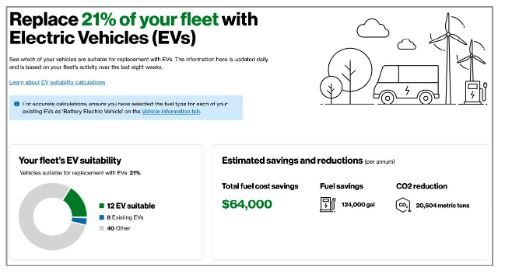
Research and support tools can provide options for EV model selection, incentive eligibility and charging needs as managers determine the best approach for their specific fleet operations and goals. Through Verizon Connect’s integration with select partners, fleets also gain data and insights into:
Finding the right partner is the first step in a successful EV rollout. Download our Fleet Management Software Buyer’s Guide to evaluate essential features and security protocols.
Adding EVs to a fleet changes availability, energy use, charging, maintenance, routing and total cost of ownership. Without connected software, these operational variables create departmental silos that obscure your true return on investment.
The right electric vehicle fleet management software turns operational complexity into a streamlined, data-driven workflow. By uniting EV and ICE metrics within one platform, you can ensure vehicles are charged and ready, optimize energy expenses, and make confident deployment decisions.
As your fleet grows, the centralized visibility of EV fleet management systems becomes essential. Consistent reporting and fleet-wide analytics establish repeatable best practices, ensuring your electrification strategy scales efficiently and profitably over time.
Schedule a demo to see how Reveal can help you monitor vehicle readiness, control operating costs and support a more scalable approach to EV fleet management.
1 Trends in electric car markets, The International Energy Agency, 2026

Tags: Vehicle Maintenance, Service level compliance, Data & Analytics


Find out how our platform gives you the visibility you need to get more done.
Learn how an integrated telematics platform can help boost your bottom line through efficiency gains, customer service...
Read moreLearn how to use EV suitability analytics and telematics data to assess vehicles and create a fleet electrification strategy...
Read moreExplore our participation in the BAR Continuous Testing Program for government fleets in California.
Read moreThe 2026 Fleet Technology Trends Report chronicles the latest fleet management technology and AI-driven tools fleet professionals...
Read more